The companion to the $450 Stevens 44½: an original Model 44, bought
the same way, with no palm rest and no scope — just the iron sights it left the factory with. This one is staying exactly
as it is. No scope, no palm rest, no "improvements." The point of this rifle is to find out how well a hundred-year-old
Stevens shoots the way Stevens built it.
J. Stevens Arms Company
MODEL 44 · HEAVY SCHUETZEN
Chicopee Falls, Mass. · U.S.A.
Action"Ideal" tipping block · heavy Schuetzen frame (44½-size)
Same story as the 44½: found on an online auction site and bought for $350 as a plain rifle — no
palm rest, no scope, no scope blocks — with its original iron sights in place. For reference, plain original 44s in
.22 have been bringing roughly $300 to $650 at online auction lately, while examples with strong case colors and their
original tang sights are priced by dealers at two to four times that. This one has the colors and the sights. It
cost $350.
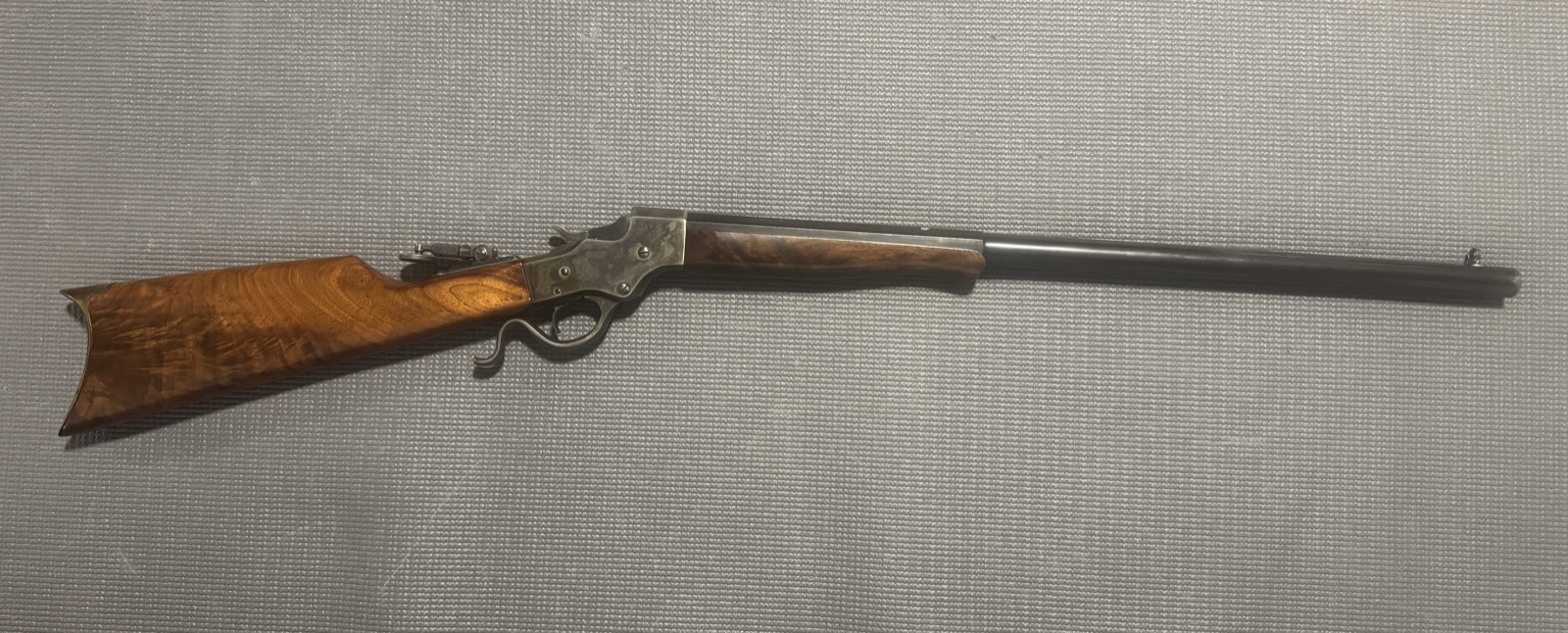
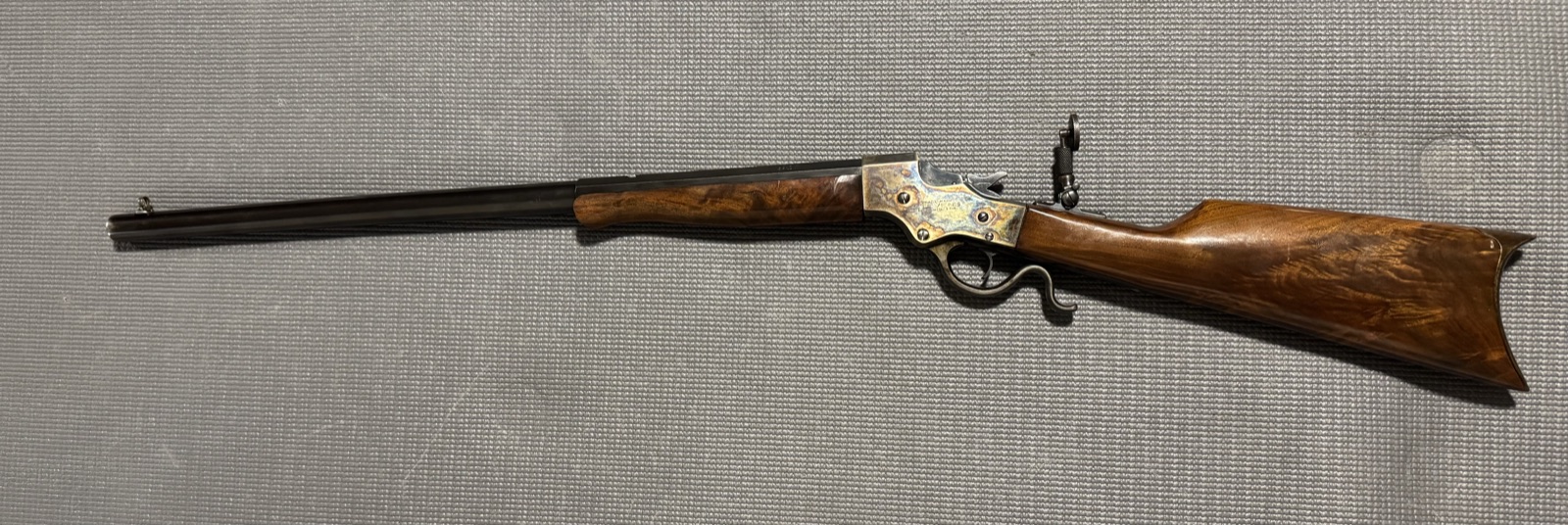
Fig. 1The Model 44 as it sits: half-octagon barrel, case-colored frame, tang peep sight, figured walnut, and a deep crescent rifle buttplate. Nothing on this rifle has been added or changed.Fig. 2From the other side: the heavy Schuetzen frame wearing its colors, the spur lever, the tang peep standing up, and the figure in both pieces of wood.
The Rifle's Story
The Stevens company history — Chicopee Falls, the Pope years, the 1915 sale and the end of the Arms
& Tool era — is told in full in the 44½ article. This is the short version,
about the Model 44 itself.
The "Ideal"
The Model 44 arrived about 1894 as the first of Stevens' Ideal rifles, and for
a decade it was the Stevens single-shot. Every grade in the catalog — the plain No. 44, the Range, the Walnut
Hill, the Schuetzens, even the first Stevens-Pope rifles of 1902 — was built on this action until the 44½ took over
the high grades in 1903–04. The patent date rolled into its barrels, April 17, 1894, is U.S. patent
518,448, granted to Edward H. Elder of Chicopee for the action's pivoting breech block, its triangular link, and a
wear-compensating screw. Whether Elder designed the rifle or simply held the patent as a Stevens
employee is not established.
This isn't the plain No. 44, either. It's built on the 44 Heavy Schuetzen frame — the wider, deeper
receiver Stevens made for its Schuetzen grades, about half a pound heavier than the standard 44 and, in its outside
dimensions, the same size as the 44½ that would replace it. Set the two rifles in this column side by side and the
frames match. That heavy frame carried the Schuetzen grades — the Nos. 50 through 53, the Schuetzen Special, and the
first Stevens-Pope rifles — until the 44½ took that work over in 1903–04. Which is to say: this rifle was built to
stand on the 200-yard line, not to plink.
And that is the difference between the two rifles in this column. The 44's breech block doesn't fall straight down
in a mortise the way the 44½'s does; it pivots on a central screw and swings down and back on the
lever's link. It is a lighter, simpler, black-powder-era action — strong enough for rimfires and the mild centerfires
it was chambered for, and never meant for the pressures the 44½ was built to take. Stevens knew it: once the 44½
existed, the 44 was dropped in the big cartridges and kept on in .22, .25, and .32 rimfire and a
couple of small centerfires. It stayed in the catalog, rimfire only, until 1932 — a dozen years into
the Savage ownership and sixteen years after the 44½ was gone. Roughly a hundred thousand were made.
When was this one built?
No factory records survive for the 44 either, so the rifle has to speak for itself. First, what it is: the lower
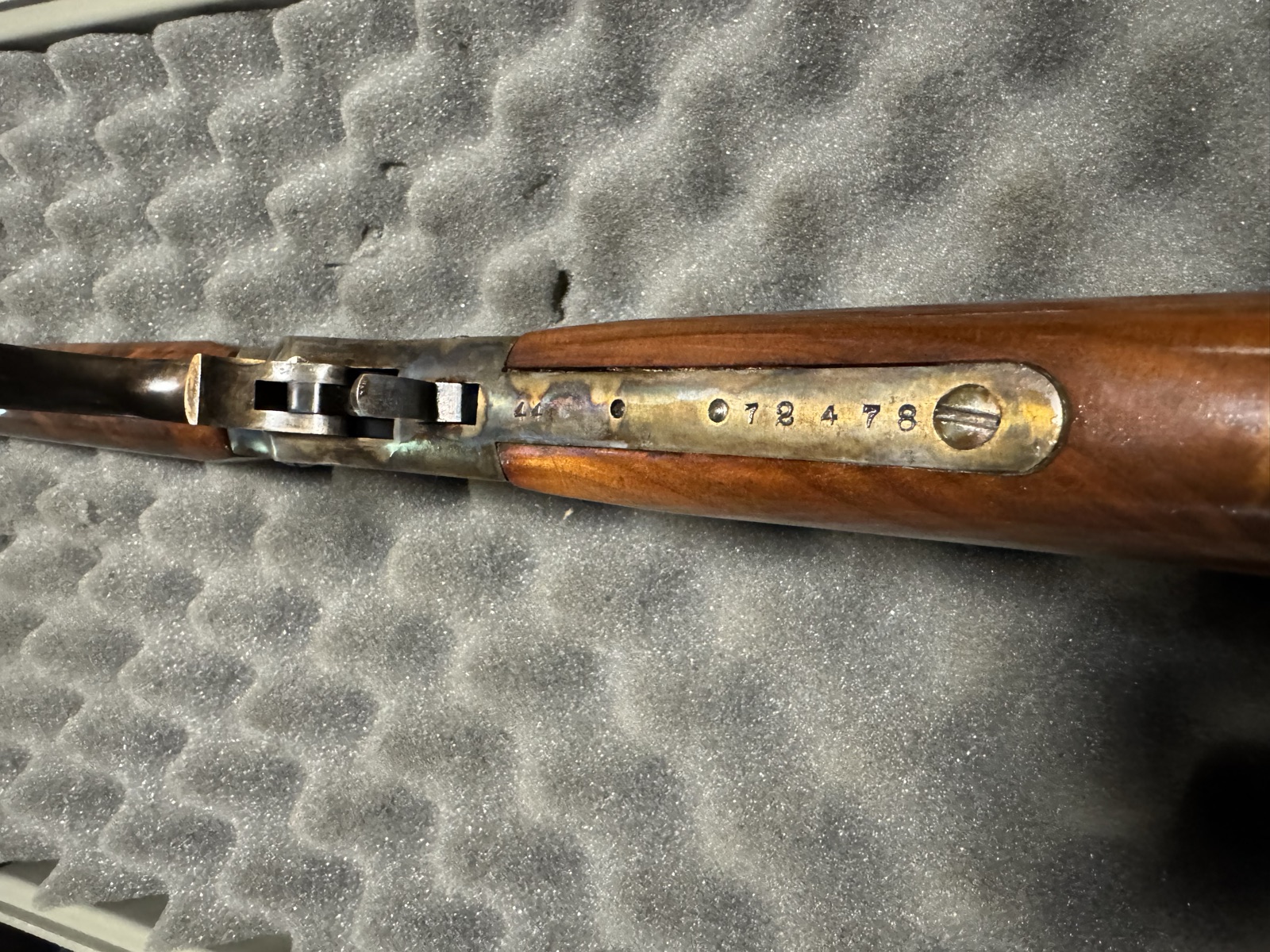
tang is stamped a plain 44, in the same place the 44½ carries its 44½ stamp — Stevens marked
the model on the tang, and the stamp is the quickest way to know which action you're holding. Then, when it was
built, in three places:
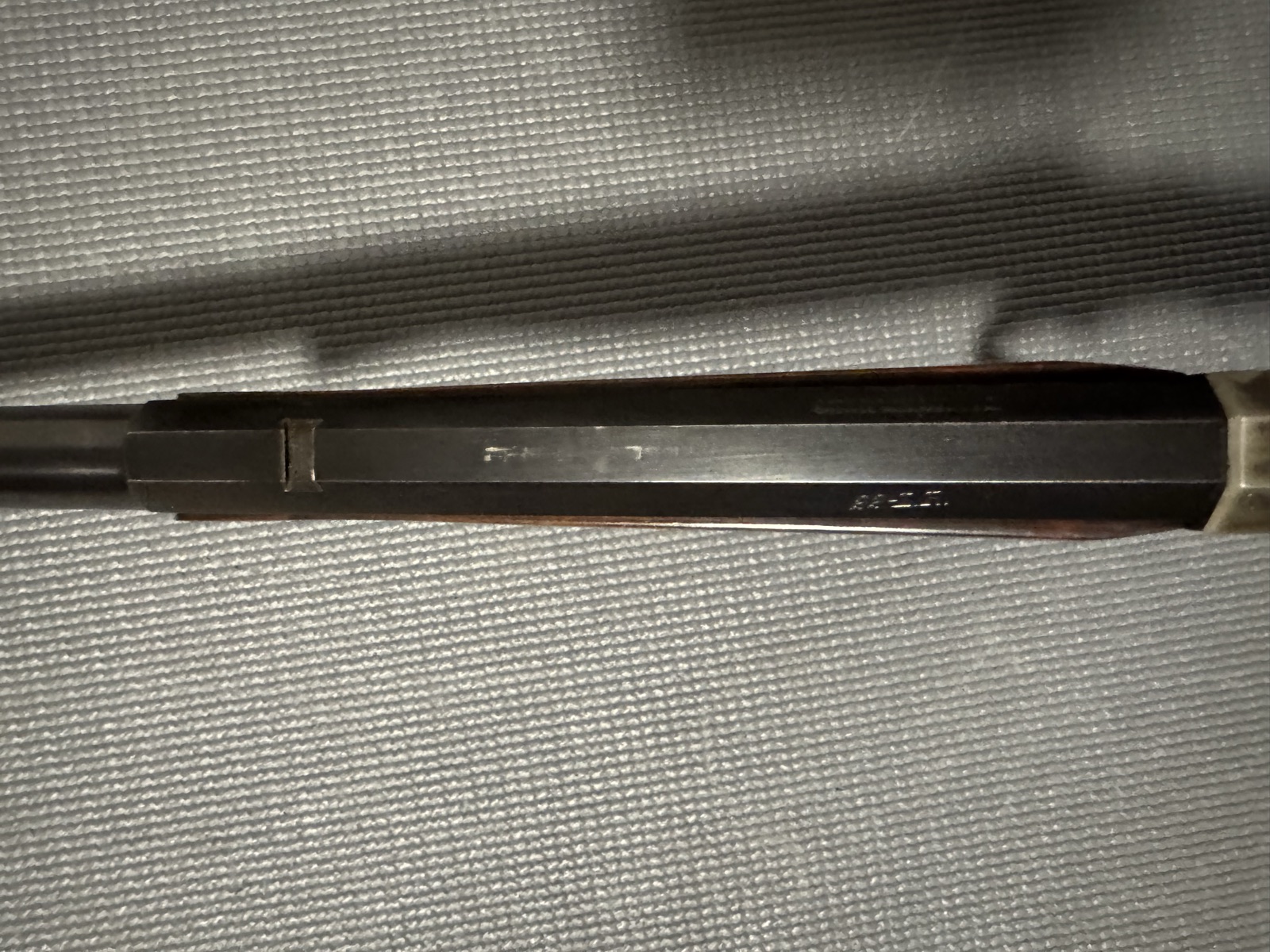
The caliber. The barrel is stamped .22 L.R. — a rimfire-only chambering, which is
what the 44 was being built in after the 44½ took over the centerfire work in 1903–04.
The serial.72478 sits at the very top of the range collectors have surveyed
for the 44. The ASSRA serial study puts the switch to the later two-piece breech bolt around 17,000 (about 1901),
and records the late "Trade Mark"-marked receivers of the Savage years beginning in the 71,000s.
This rifle is a few hundred past that line.
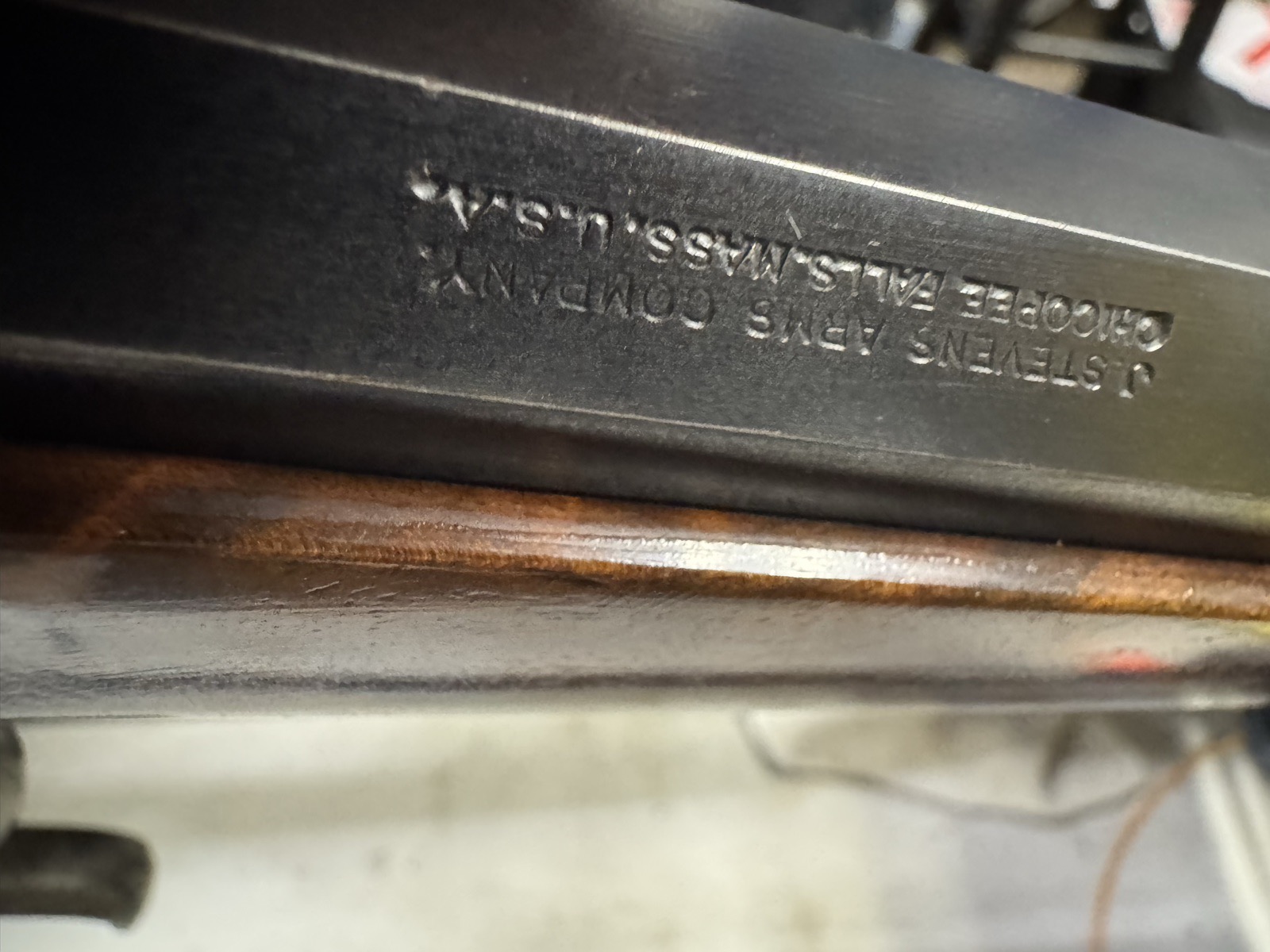
The barrel address. "J. Stevens A. & T. Co." means before July 1916; "J. Stevens Arms
Company" means July 1916 to April 1920; a Savage-era mark means after that. This barrel reads "J. Stevens
Arms Company" — the same stamp as the 44½ in this column.
Three witnesses, one answer. The serial puts the rifle at the top of the surveyed range; the rimfire chambering
puts it after 1903–04; and the barrel stamp pins it between July 1916 and April 1920 — the four
years the company called itself the J. Stevens Arms Company, after the Westinghouse purchase and before Savage. This
is a 1916–1920 Model 44, built in the last years the Ideal was offered under the Stevens name.
Two things follow from that. First, the heavy Schuetzen frame was still being built and sold years
after the catalogs moved the Schuetzen grades to the 44½ — this rifle is the proof, and it suggests
the heavy-frame 44 stayed in production for the Schuetzen trade longer than the published grade tables show.
Second, and this is the twist: the rifle with the older action is the younger rifle. The 44½ beside it in
this column was one of the last of its kind in 1916; this 44 was built after that, as the Schuetzen world both
rifles were made for was closing down around them.
What the dating doesn't change is the point of the rifle. The action was a 1894 design, the case hardening was
standard on every grade and every year, the sights are the ones Stevens fitted, and the whole thing is exactly as it
left the factory. Rifles don't get more honest than that.
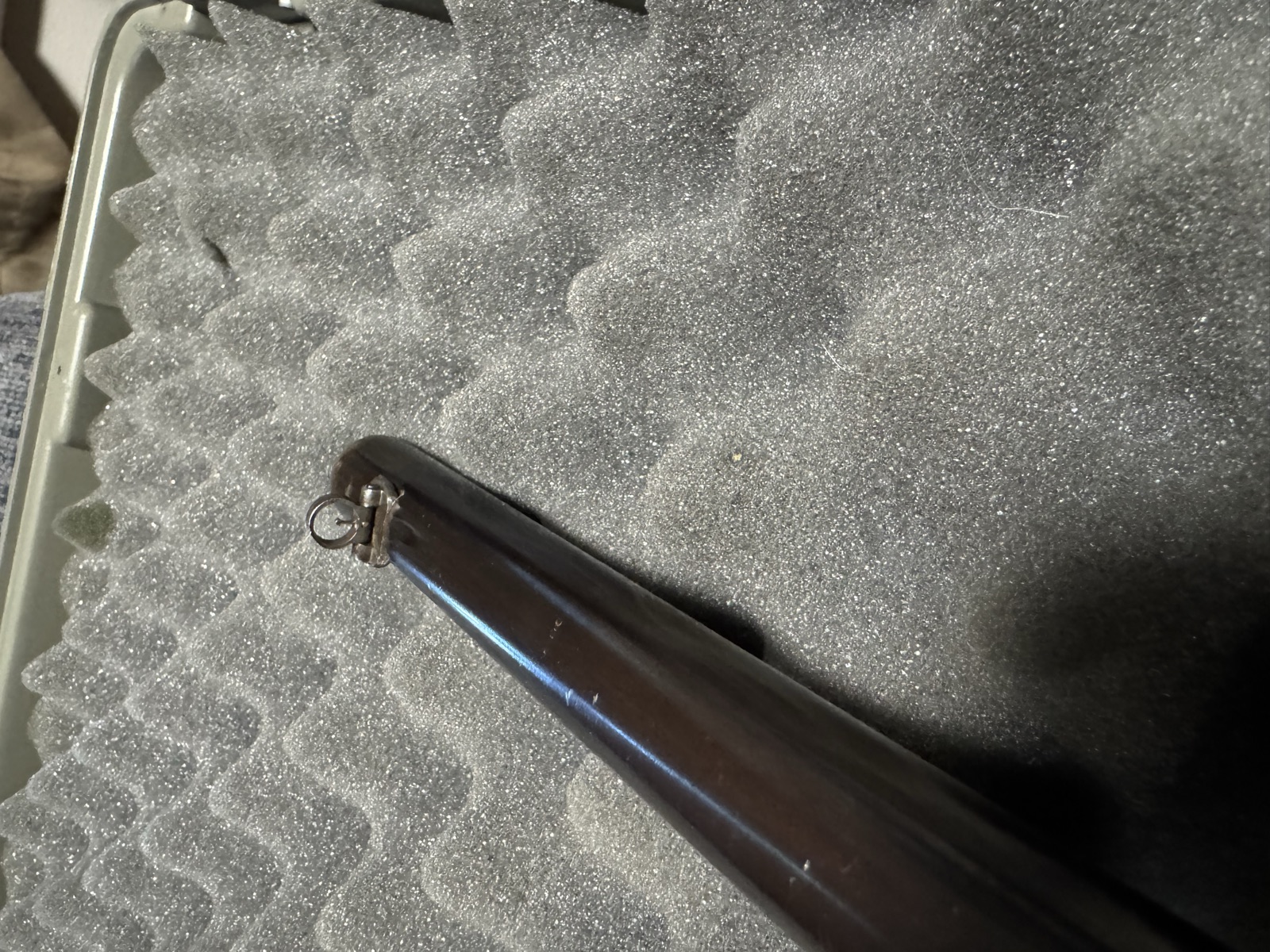
Fig. 3The top flat of the barrel: stamped .22 L.R. ahead of the frame, and a rear-sight dovetail carrying a blank — the tang peep does the aiming, so the barrel slot was filled, as Stevens did on its peep-sighted rifles.Fig. 4The barrel address: J. STEVENS ARMS COMPANY · CHICOPEE FALLS, MASS. U.S.A. — the post-1916 name, and the tiebreaker.Fig. 5The lower tang: a straight 44 model stamp ahead of serial 72478 — in exactly the spot where the 44½ wears its 44½ — and case color still on the tang itself. If you ever need to tell the two apart in the dark, this is where to feel for it. What the number says about the rifle's age follows below.
Original & Untouched
This rifle is exactly as it left Chicopee Falls, less a century of honest use. Nobody has refinished it, rebarreled
it, restocked it, or "upgraded" its sights. That is rarer than it sounds for a working target rifle, and it's the whole
reason this one is staying that way.
Here is why it matters to a collector, and why it should matter to a shooter. The case colors wear first and fade
first — they are the canary. A frame that still shows this much blue and straw has never been polished, never been
hot-blued over, never been "cleaned up" for sale. Dealers put a two- to four-times premium on a Stevens that still
wears its colors, because the colors are proof of everything else: that the sights are the factory sights, that the
barrel is the factory barrel, that nobody with a buffing wheel ever got near it.
Beyond that I'm not sure I'd add much, because in most respects this rifle is very much like the 44½ — same
family, same ideas, same way of doing things. The differences are in the details, and the details are what the rest
of this page is about.
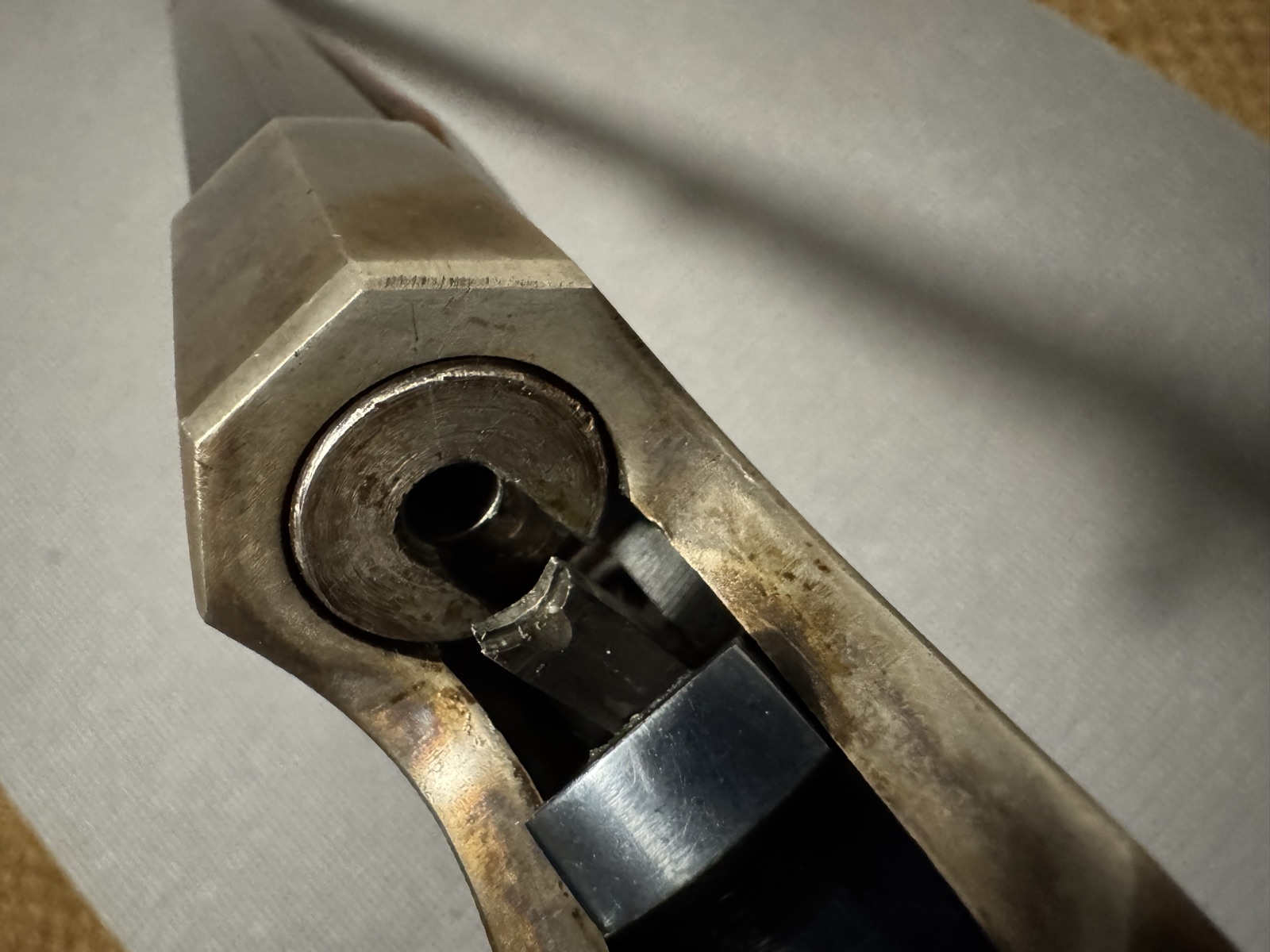
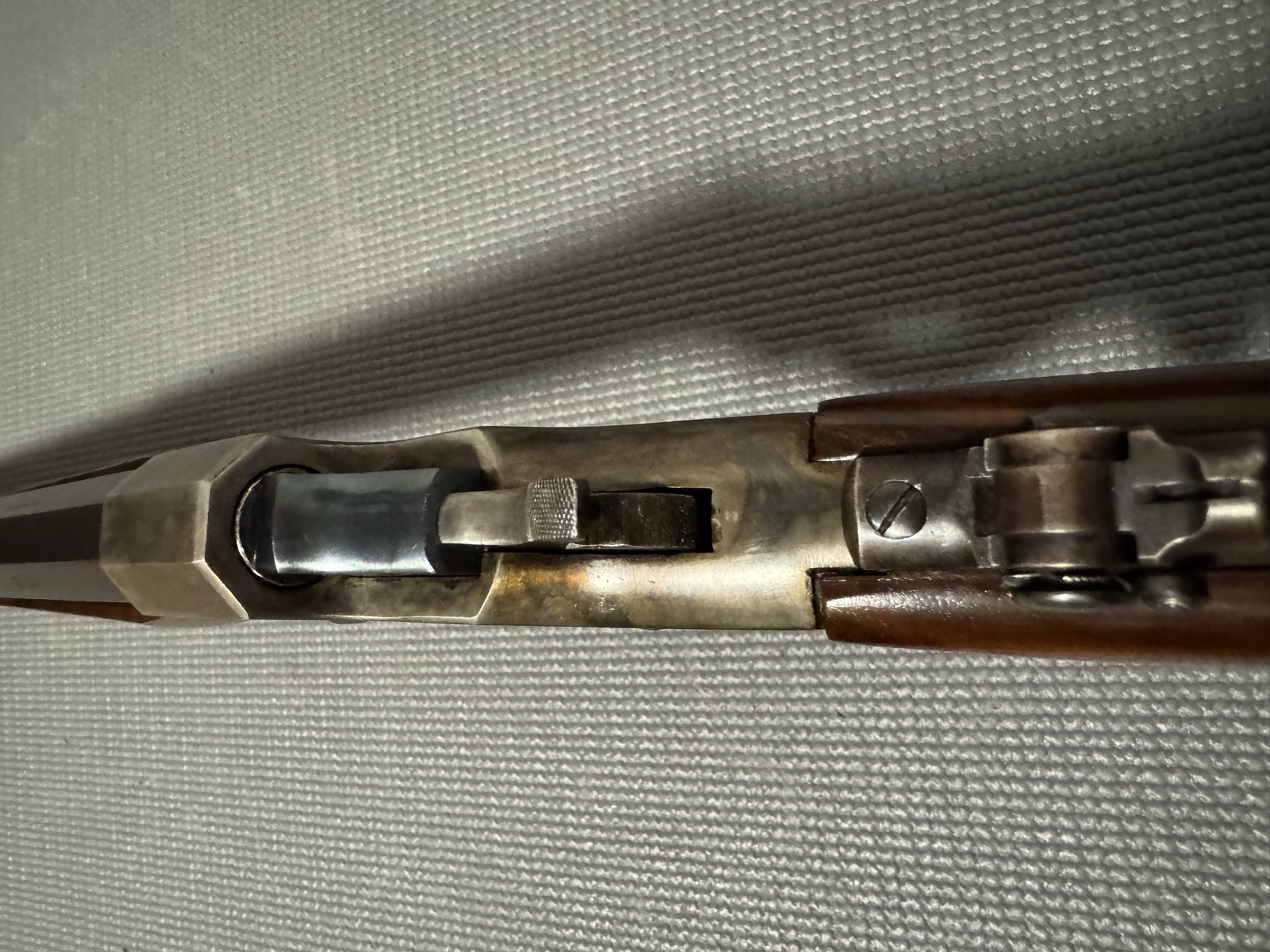
Fig. 6Close in on the open action: the chamber mouth in the octagon breech, the half-moon extractor at rest, and case color still on the frame right where a hundred years of thumbs have been.
The Sights
No scope, and no scope blocks either, because the rifle never had a scope. What it has is what Stevens sold with
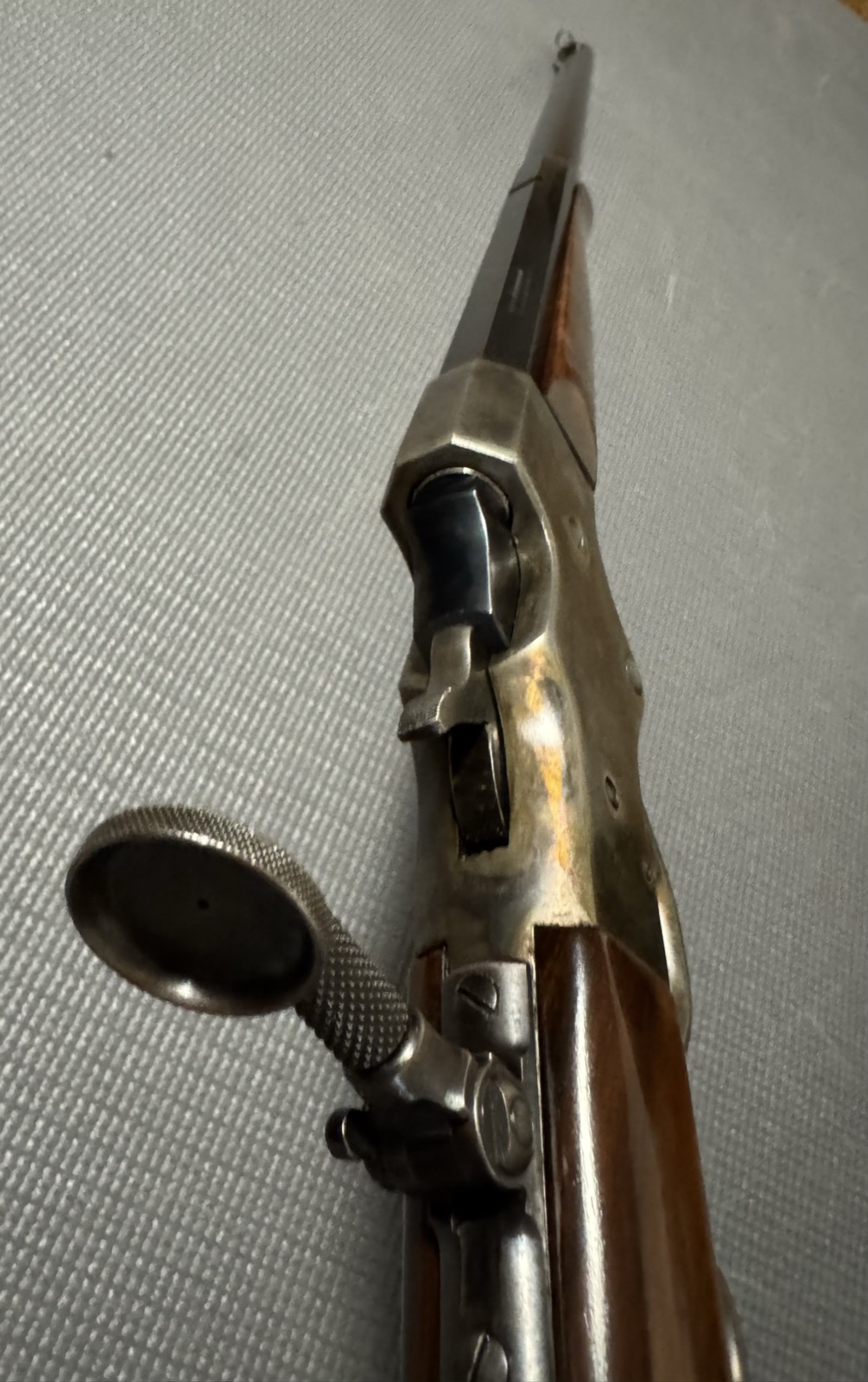
its peep-sighted grades: a tang-mounted peep sight behind the hammer, with a large knurled aperture
disc on a staff that folds down out of the way, and a fine front sight out on the muzzle in its own
dovetail. The rear dovetail on the barrel carries a blank, which is how Stevens shipped a rifle meant to be aimed from
the tang.
They are fun, and they are easy to use — a clean aperture, a fine front, and nothing to fiddle
with once it's set. What I would not want to do is adjust them during a match. The tang sight's elevation
staff is a fine instrument, but it's a fine instrument from 1900, and cranking it up and down between distances on
the clock is a good way to lose a relay. For a match with multiple distances I'd set it once and hold off
— put the bead where experience says it needs to be and trust the hold. That's how the old-timers did it, too.
This is the aiming system every Schuetzen shooter of the 1890s used before the long tube scopes took over, and it is
the system the Vintage Iron class at NPS is built around. A small aperture close to the eye, a fine bead or pinhead
far from it, and a steady hold. That's the whole trick, and it's enough for a 230.
Fig. 7The rear sight: a tang-mounted peep with a big knurled disc, standing up on its staff behind the open breech. This is the sight the rifle was aimed with in 1900, and the one it will be aimed with now.Fig. 8The front sight, out at the muzzle on its dovetail: small, fine, and original. Between it and the tang peep is a hundred-year-old sight picture that still works.
The Wood & the Colors
It is no coincidence, compared with the 44½: both of these rifles wear wood that would make a modern buyer pay
extra.
And then there's the frame. This one still carries a great deal of its original case coloring —
the mottled blues, straws, and greys of the hardening process. Stevens color-case-hardened the frame, hammer, and
lever on every grade of the 44, every year it was made, so the colors aren't a sign of a fancy grade — they're a sign
of a rifle that was never refinished. They fade fast with handling and vanish under a rebluing. Seeing this much of
them left, on the frame, the lever, and even the lower tang, tells you the rifle was cared for and never "restored."
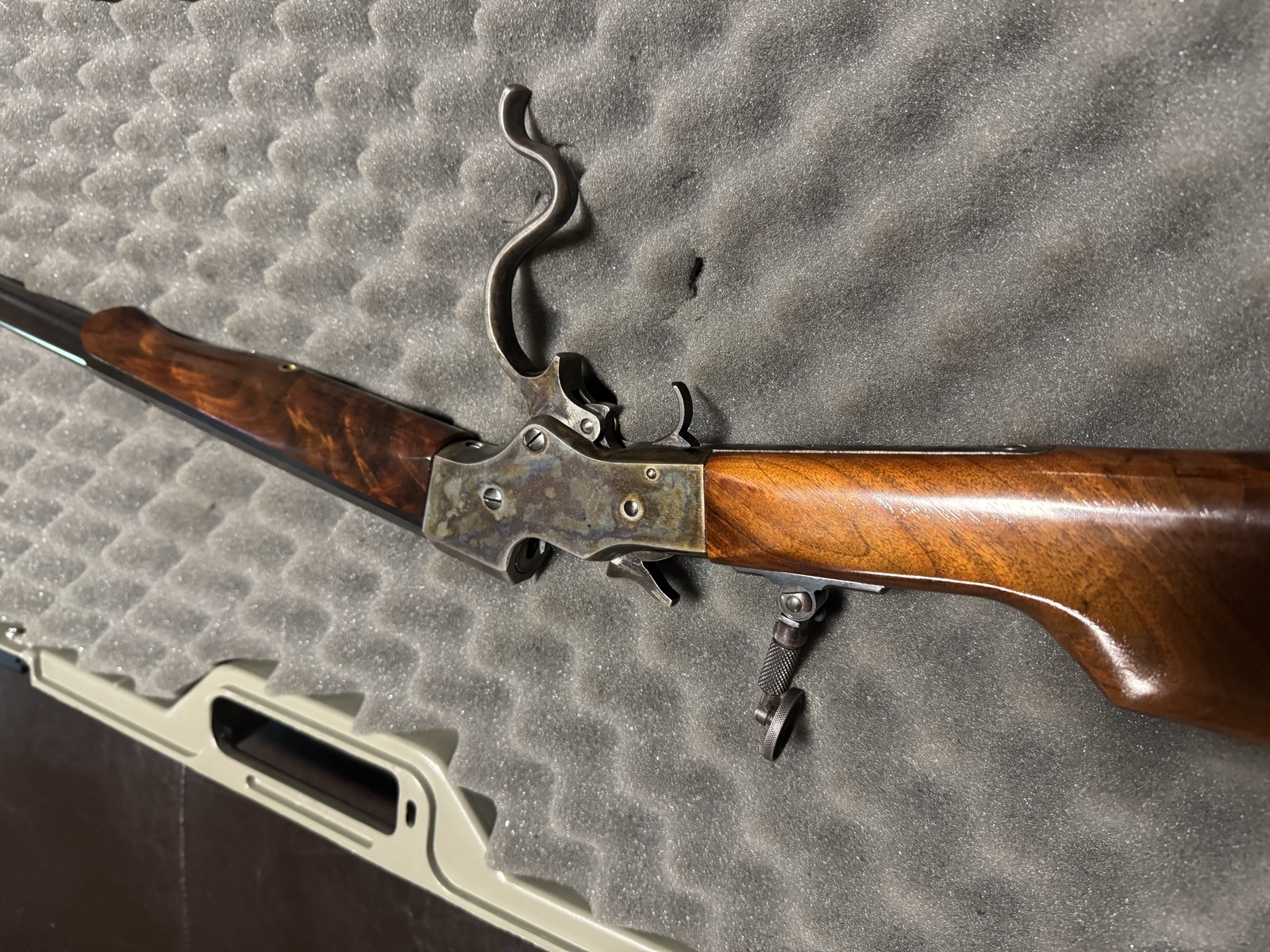
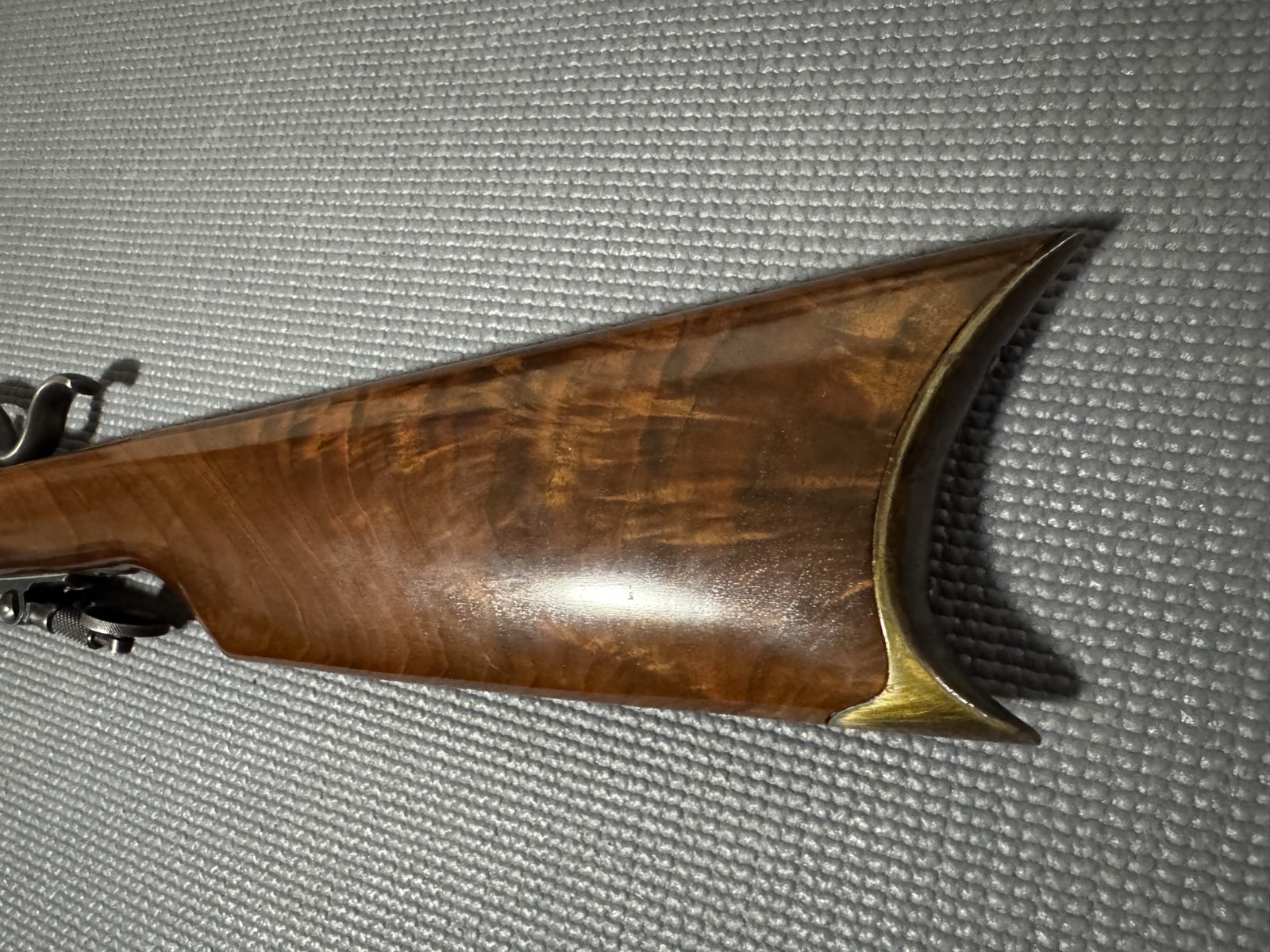
Fig. 9From above, breech open: the mottled blues, straws, and greys of the original case hardening, still vivid on the top of the frame.Fig. 10Lever down, from the side: blues and straws across the whole frame and lever, the figured forend ahead of it, and the butt behind. This is what "untouched" looks like.Fig. 11The buttstock: rolling figure through the whole butt, and the crescent rifle buttplate — not the pronged Schuetzen hook of the 44½ — worn to a soft gold at heel and toe.
Shooting It As-Is
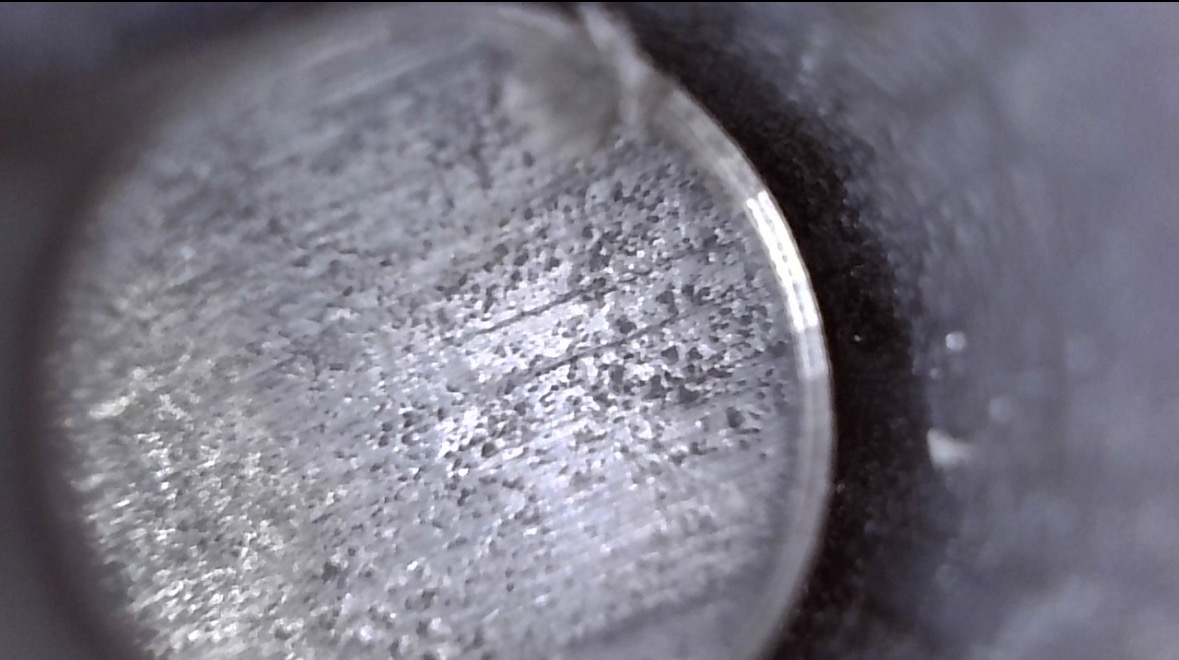
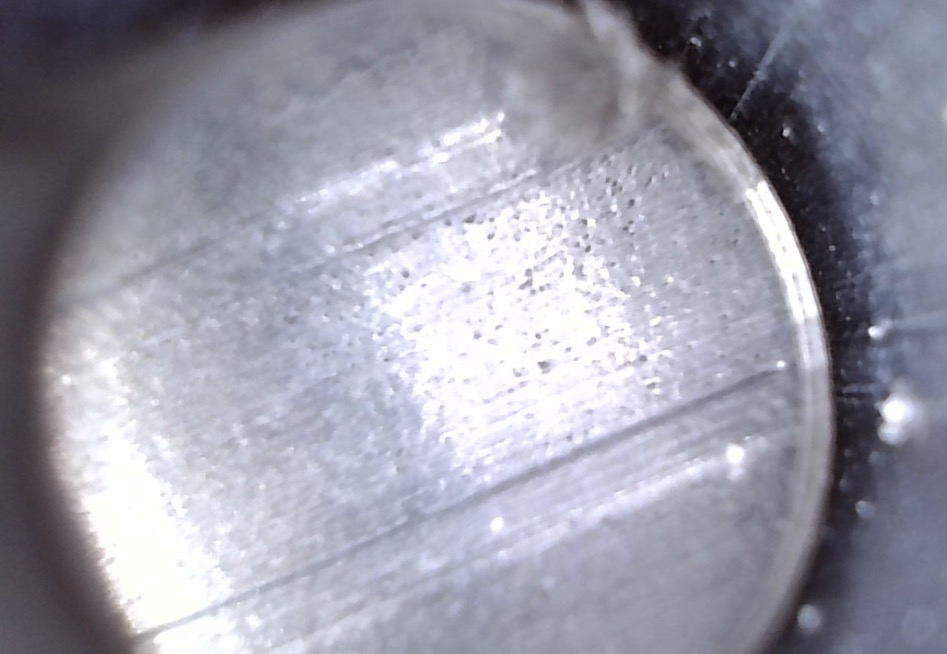
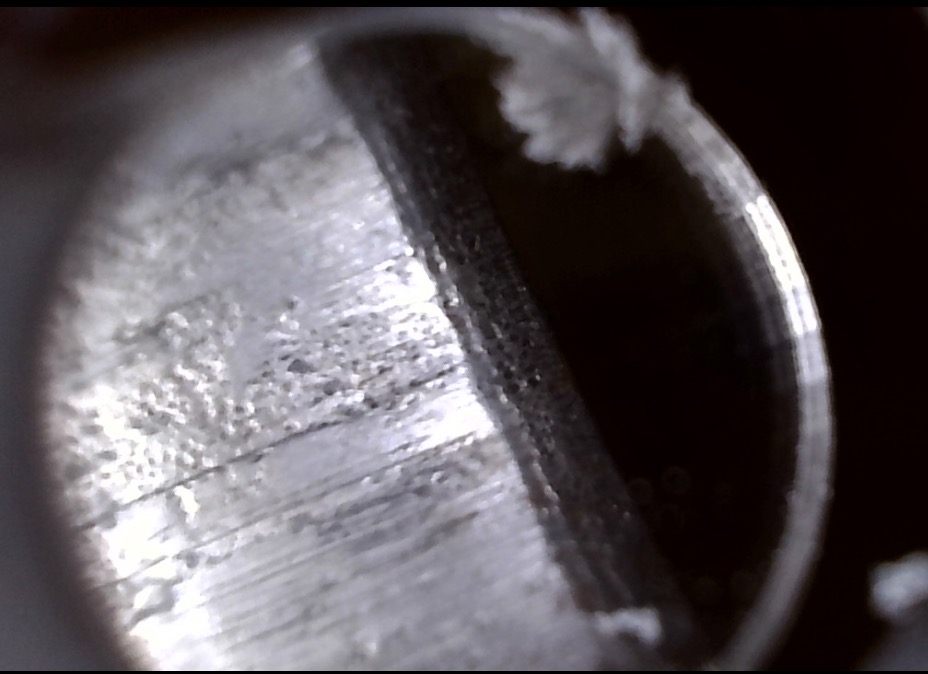
The bore isn't as pristine as the 44½'s, but it still shoots a good group. And that's the experiment: with the
original irons, no scope, no palm rest, I'm confident this rifle can still post a 230-plus on the
250-point Schuetzen target. We'll find out on the line. [Groups and scores to come.]
What the bore would tell you
Look at that bore again, and don't apologize for it. She has been around the block. Every one of those pits is a
day somebody loaded this rifle and pulled the trigger — and between 1916 and now there have been a lot of days.
So think about it. How many hands has this rifle passed through? A man bought it new, when it was built for the
Schuetzen line and a Schuetzen line still existed. The matches faded and the rifle didn't, so it went to work. How
many kids learned to shoot on it — a boy with a box of shorts and a tin can on a fence post, a girl walking a creek
bottom for cottontails, a grandson told to keep the muzzle pointed down range and don't you dare dry-fire it?
How many squirrels, how many rabbits, how much small game came home because of this barrel? How many times was it
leaned in the corner of a kitchen, or ridden behind the seat of a pickup, or cleaned at a table by lamplight with a
rag and whatever oil was handy? And every .22 round made before 1927 was primed with potassium chlorate — corrosive, and the old-timers knew it, which
is why the rifle got cleaned at that table at all. Rustless priming came first to the .22 rimfires, with Remington's
Kleanbore in 1927, but by then this rifle was already ten years into its working life. Those years etched every one
of those trips into the steel, and nobody ever polished them out.
That's what you're looking at down that borescope: a century of ordinary American days. The 44½'s mirror bore is
a marvel. This one is a time machine. It's been in more hands than I will ever know, it taught more
people to shoot than I ever will, and it still groups. If it could talk, I'd put the coffee on and sit a while.
Two rules for shooting a 44 as it was built. First, standard-velocity .22 only: the pivoting block
was designed for black-powder pressures, and the old-timers on the Stevens forums are unanimous that high-velocity
rimfire has no business in it. Second, keep the lever and block tension snug — the pivot screw, the
link pins, and the tension screw are the wear points on a 44, and a loose lever means growing headspace. The
wear-compensating screw in Elder's patent is there for exactly this.
How it handles: it's light, and it holds very well even without a palm rest. The
crescent rifle butt, it turns out, does a lot of the work the Schuetzen hook does on the 44½ — it seats under the arm
and keeps the rifle from walking — and with the lighter frame-and-barrel the whole thing settles on the target
without the extra hardware. I'm not adding a palm rest.
And the trigger, since the 44½ article made a point of it: the 44's trigger is very nice — right at
about a pound, as it sits. That's the number I could never reach on the 44½ no matter how much I
polished, and it's the number the 44 came to me with. Factory 44 pulls ran five or six pounds; whether this one is a
century of wear or a long-ago trigger job, I don't know — and I'm not going to touch it.
Frosted, with pitting
Lands and grooves still sharp
Groove edge, with a little fouling
Fig. 12Down the bore. This is the honest part: frosted steel and scattered pitting from the corrosive chlorate priming that every .22 cartridge carried until Remington's Kleanbore arrived in 1927 — a decade into this rifle's life — nothing like the mirror bore of the 44½. But look at the groove edges — still square, still deep. A .22 cares far more about the rifling and the crown than about the finish between them, and this one still groups.
📷Fig. 13A group, iron sights.
Sources & Further Reading
Historical statements are drawn from the references below and from collector consensus; anything marked in red
is disputed or unverified. See also The $450 Stevens 44½ and The
Rifles & Their Makers.
 Frosted, with pitting
 Lands and grooves still sharp
 Groove edge, with a little fouling